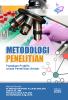
METODOLOGI PENELITIAN: Panduan Praktis untuk Penelitian Ilmiah
Keywords:
Metodologi Penelitian Ilmiah, Paradigma Kuantitatif dan Kualitatif, Etika Penelitian, Instrumen dan Skala PengukuranSynopsis
Buku ini hadir sebagai panduan komprehensif bagi akademisi dan praktisi dalam memahami seluk-beluk penelitian ilmiah secara sistematis. Pembahasan dimulai dari prinsip dasar metodologi, etika penelitian, hingga karakteristik sikap yang harus dimiliki seorang peneliti profesional. Penulis menekankan pentingnya integritas dan logika dalam setiap langkah investigasi agar hasil yang didapatkan valid, objektif, serta dapat dipertanggungjawabkan secara ilmiah.
Selanjutnya, pembaca diajak mengeksplorasi berbagai paradigma utama seperti positivisme dan interpretivisme yang melandasi pendekatan kuantitatif, kualitatif, maupun metode campuran. Buku ini mengupas tuntas cara mengidentifikasi masalah penelitian yang signifikan serta teknik menyusun tinjauan pustaka yang kuat. Penjelasan mendalam mengenai desain penelitian, populasi, dan teknik sampling juga diberikan untuk memastikan proses pengambilan data dilakukan dengan prosedur yang tepat.
Pada bagian akhir, fokus beralih pada instrumen penelitian, skala pengukuran, serta pengujian validitas dan reliabilitas data. Penulis memberikan perhatian khusus pada aspek analisis data dan penggunaan teknologi terkini untuk membantu peneliti menghasilkan simpulan yang akurat. Buku ini menjadi referensi esensial yang menyeimbangkan teori dan praktik, guna membantu mahasiswa maupun peneliti dalam menyusun laporan atau artikel ilmiah yang berkualitas tinggi.
References
American Psychological Association. (2020). Publication Manual of the American Psychological Association (7th ed.). American Psychological Association.
Anderson, L. W., & Krathwohl, D. R. (Eds.). (2001). A Taxonomy for Learning, Teaching, and Assessing: A Revision of Bloom's Taxonomy of Educational Objectives. New York: Longman.
Arikunto, S. (2013). Prosedur Penelitian: Suatu Pendekatan Praktik. Jakarta: Rineka Cipta.
Azwar, S. (2012). Reliabilitas dan Validitas (Edisi 4). Yogyakarta: Pustaka Pelajar.
Barney, J. (1991). Firm resources and sustained competitive advantage. Journal of Management, 17(1), 99-120.
Baron, R. M., & Kenny, D. A. (1986). The moderator-mediator variable distinction in social psychological research: Conceptual, strategic, and statistical considerations. Journal of Personality and Social Psychology, 51(6), 1173-1182.
Booth, A., Sutton, A., & Papaioannou, D. (2016). Systematic approaches to a successful literature review (2nd ed.). Sage Publications.
Cook, T. D., & Campbell, D. T. (1979). Quasi-experimentation: Design and analysis issues for field settings. Rand McNally.
Cooper, D. R., & Schindler, P. S. (2014). Business research methods (12th ed.). McGraw-Hill.
Creswell, J. W. (2014). Research design: Qualitative, quantitative, and mixed methods approaches (4th ed.). Sage Publications.
Creswell, J. W., & Creswell, J. D. (2018). Research Design: Qualitative, Quantitative, and Mixed Methods Approaches (5th ed.). Thousand Oaks, CA: Sage Publications.
Creswell, J. W., & Miller, D. L. (2000). Determining Validity in Qualitative Inquiry. Theory Into Practice, 39(3), 124-130.
Cronbach, L. J. (1951). Coefficient Alpha and the Internal Structure of Tests. Psychometrika, 16(3), 297-334.
Davis, F. D. (1989). Perceived usefulness, perceived ease of use, and user acceptance of information technology. MIS Quarterly, 13(3), 319-340.
Depdiknas. (2008). Panduan Penulisan Butir Soal. Jakarta: Direktorat Pembinaan Sekolah Menengah Atas.
Eriyanto. (2011). Analisis Isi: Pengantar Metodologi untuk Penelitian Ilmu Komunikasi dan Ilmu-Ilmu Sosial Lainnya. Jakarta: Kencana.
Fowler, F. J. (2014). Survey Research Methods (5th ed.). SAGE Publications.
Gay, L. R., & Diehl, P. L. (1992). Research Methods for Business and Management. Macmillan Publishing Company.
Geertz, C. (1973). The Interpretation of Cultures. New York: Basic Books.
Ghozali, I. (2018). Aplikasi Analisis Multivariate dengan Program IBM SPSS 25 (Edisi 9). Semarang: Badan Penerbit Universitas Diponegoro.
Glaser, B. G., & Strauss, A. L. (1967). The Discovery of Grounded Theory: Strategies for Qualitative Research. Aldine Publishing Company.
Groves, R. M., Fowler, F. J., Couper, M. P., Lepkowski, J. M., Singer, E., & Tourangeau, R. (2009). Survey Methodology (2nd ed.). John Wiley & Sons.
Gwet, K. L. (2014). Handbook of Inter-Rater Reliability (4th ed.). Gaithersburg, MD: Advanced Analytics, LLC.
Hair, J. F., Black, W. C., Babin, B. J., & Anderson, R. E. (2019). Multivariate data analysis (8th ed.). Cengage Learning.
Hart, C. (1998). Doing a literature review: Releasing the social science research imagination. Sage Publications.
Hasibuan, M. S. P. (2016). Manajemen sumber daya manusia (Edisi Revisi). Bumi Aksara.
Hatch, E., & Farhady, H. (1982). Research design and statistics for applied linguistics. Newbury House Publishers.
Herzberg, F., Mausner, B., & Snyderman, B. B. (1959). The motivation to work. John Wiley & Sons.
Isaac, S., & Michael, W. B. (1981). Handbook in Research and Evaluation (2nd ed.). EdITS Publishers.
Jamieson, S. (2004). Likert scales: How to (ab)use them. Medical Education, 38(12), 1217-1218.
Kalton, G. (1983). Introduction to Survey Sampling. SAGE Publications.
Kerlinger, F. N. (1973). Foundations of behavioral research (2nd ed.). Holt, Rinehart and Winston.
Kish, L. (1965). Survey Sampling. John Wiley & Sons.
Krippendorff, K. (2004). Content Analysis: An Introduction to Its Methodology (2nd ed.). Thousand Oaks, CA: SAGE Publications.
Krueger, R. A., & Casey, M. A. (2015). Focus Groups: A Practical Guide for Applied Research (5th ed.). Thousand Oaks, CA: SAGE Publications.
Kvale, S., & Brinkmann, S. (2015). InterViews: Learning the Craft of Qualitative Research Interviewing (3rd ed.). Thousand Oaks, CA: SAGE Publications.
Mangkunegara, A. A. A. P. (2017). Manajemen sumber daya manusia perusahaan. Remaja Rosdakarya.
Mardapi, D. (2017). Pengukuran, Penilaian, dan Evaluasi Pendidikan (Edisi 2). Yogyakarta: Parama Publishing.
Mason, M. (2010). Sample Size and Saturation in PhD Studies Using Qualitative Interviews. Forum: Qualitative Social Research, 11(3), Art. 8.
Maxwell, J. A. (2013). Qualitative research design: An interactive approach (3rd ed.). Sage Publications.
Merton, R. K. (1968). Social theory and social structure (Enlarged ed.). Free Press.
Miles, M. B., Huberman, A. M., & Saldaña, J. (2014). Qualitative data analysis: A methods sourcebook (3rd ed.). Sage Publications.
Moleong, L. J. (2017). Metodologi Penelitian Kualitatif (Edisi Revisi). Bandung: PT Remaja Rosdakarya.
Morse, J. M. (1994). Designing Funded Qualitative Research. In N. K. Denzin & Y. S. Lincoln (Eds.), Handbook of Qualitative Research (pp. 220-235). SAGE Publications.
Nazir, M. (2014). Metode Penelitian. Bogor: Ghalia Indonesia.
Neuman, W. L. (2014). Social research methods: Qualitative and quantitative approaches (7th ed.). Pearson Education Limited.
Norman, G. (2010). Likert scales, levels of measurement and the "laws" of statistics. Advances in Health Sciences Education, 15(5), 625-632.
Nunnally, J. C. (1978). Psychometric theory (2nd ed.). McGraw-Hill.
Parasuraman, A., Zeithaml, V. A., & Berry, L. L. (1988). SERVQUAL: A multiple-item scale for measuring consumer perceptions of service quality. Journal of Retailing, 64(1), 12-40.
Patton, M. Q. (2002). Qualitative Research and Evaluation Methods (3rd ed.). SAGE Publications.
Popper, K. R. (1959). The logic of scientific discovery. Hutchinson.
Riduwan. (2015). Skala Pengukuran Variabel-Variabel Penelitian. Bandung: Alfabeta.
Sekaran, U., & Bougie, R. (2016). Research methods for business: A skill building approach (7th ed.). John Wiley & Sons.
Siegel, S., & Castellan, N. J. (1988). Nonparametric statistics for the behavioral sciences (2nd ed.). McGraw-Hill.
Stevens, S. S. (1946). On the theory of scales of measurement. Science, 103(2684), 677-680.
Stewart, D. W., Shamdasani, P. N., & Rook, D. W. (2007). Focus Groups: Theory and Practice (2nd ed.). Thousand Oaks, CA: SAGE Publications.
Sudjana, N. (2016). Penilaian Hasil Proses Belajar Mengajar (Cetakan ke-20). Bandung: PT Remaja Rosdakarya.
Sugiyono. (2017). Metode Penelitian Kuantitatif, Kualitatif, dan R&D. Alfabeta.
Sugiyono. (2019). Metode Penelitian Kuantitatif, Kualitatif, dan R&D (Edisi 2). Bandung: Alfabeta.
Sukmadinata, N. S. (2012). Metode Penelitian Pendidikan. Bandung: PT Remaja Rosdakarya.
Tajfel, H., & Turner, J. C. (1979). An integrative theory of intergroup conflict. In W. G. Austin & S. Worchel (Eds.), The social psychology of intergroup relations (pp. 33-47). Brooks/Cole.
Tuckman, B. W. (1988). Conducting educational research (3rd ed.). Harcourt Brace Jovanovich.
Uno, H. B. (2016). Teori motivasi dan pengukurannya: Analisis di bidang pendidikan. Bumi Aksara.
Zikmund, W. G., Babin, B. J., Carr, J. C., & Griffin, M. (2013). Business research methods (9th ed.). South-Western, Cengage Learning.
Published
License

This work is licensed under a Creative Commons Attribution-NonCommercial-ShareAlike 4.0 International License.